
Our Patron Saint

Saint Kateri Tekakwitha

"Kateri was a child of nature. Her sainthood will raise the minds and hearts of those who love nature and work in ecology."

+ Bishop Stanislaus Brzana, Bishop of Ogdensburg, New York

Saint Kateri Tekakwitha (1656–1680) is a patroness of ecology, Traditional Ecological Knowledge (TEK), and Indigenous Peoples. Her life beautifully bridges the traditions of her Kanienʼkehá꞉ka (Mohawk) and Algonquin heritage and her Catholic faith.

Born at Ossernenon (in present-day Upstate New York), Kateri was the daughter of a Kanienʼkehá꞉ka chief and an Algonquin Catholic mother. At age four, a smallpox epidemic claimed her parents and brother, leaving Kateri scarred, partially blind, and orphaned. She was adopted by relatives and grew up helping tend the agricultural fields, forage for wild plants, collect firewood, and craft beadwork despite her poor eyesight.

The Indigenous worldview—rooted in traditional knowledge and gratitude for people, the natural world, and the Creator—shaped Kateri’s daily life. Her people lived in deep relationship with the land, tending fields, forests, and rivers for the good of both humanity and all living things.

When Jesuit missionaries came to her village of Caughnawaga, Kateri was moved by the Gospel. At age 20, she was baptized Catherine (“Kateri” in her language) at Easter 1676. Longing for a life wholly devoted to Christ, she eventually left her village, walking over 200 miles to the Catholic mission at Sault Saint-Louis, near Montreal.
At the mission, Kateri continued to grow in holiness. Known for her gentle spirit, quick mind, and deep prayer life, she embraced a path of humility, charity, and devotion to the Eucharist. She made a private vow of perpetual virginity in 1679, choosing to belong entirely to Jesus.

Kateri often withdrew into the forest to pray, finding the voice of God in the whisper of the trees and the rhythms of the rivers. In the woods, she would gather simple sticks and fashion small crosses, creating quiet places of prayer surrounded by the beauty of creation. Her faith and her love of nature were inseparably intertwined.

Kateri’s deep faith overflowed into her words. Though she could not read or write, she lovingly shared the stories of Jesus and the saints with those around her. People would gather to listen, captivated by the peace and beauty that radiated from her as she spoke. In her simple storytelling, Kateri taught the faith with the wisdom of one who walked closely with God.

Kateri lived the love and mercy of Christ with a pure and gentle heart.

  • She forgave those who hurt, rejected, and misunderstood her.
  • She united her suffering to the Cross, offering it for the good of others.
  • She cared tenderly for people who were sick, elderly, and most vulnerable among her people.

In her life, we glimpse the healing love of God restoring hearts, communities, and creation itself.
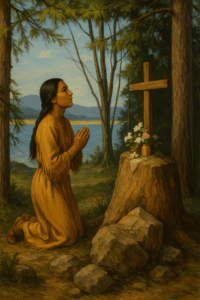
Saint Kateri praying in the woods

Having lived a life of suffering, prayer, penance, and love, Kateri’s health, always fragile, declined rapidly. She died on April 17, 1680, at the age of 24, her final words being “Jesus, I love You.” 

Veneration of Saint Kateri began almost immediately upon her death. Those who had known her witnessed the transformation of her scarred face into radiant beauty and felt her intercession powerfully. Pilgrims soon traveled to her grave, praying for her intercession and reporting favors and healings. A small chapel was built near her burial site, and devotion to Kateri spread across Indigenous and Catholic communities.

Saint Kateri is lovingly remembered as the “Beautiful Flower” (Katsitsiio in the Kanienʼkehá꞉ka language), a reflection of her pure and holy life. She continues to inspire Indigenous and non-Indigenous people alike, showing a path of healing and restoration between peoples, between humanity and all creation, and between each soul and God.

Declared Venerable in 1943, beatified in 1980, and canonized by Pope Benedict XVI in 2012, Saint Kateri is the first Native American and First Nations woman recognized as a saint. She was named a patroness of World Youth Day in 2002.

Saint Kateri’s tomb is located at the St. Francis Xavier Mission in Kahnawake, near Montreal, and she is honored at the Saint Kateri National Shrine and Historic Site in Fonda, New York. Her feast day is celebrated on July 14 in the United States and April 17 in Canada.

Kateri’s name is often pronounced as kä’tu-rē. Her Haudenosaunee name, Tekakwitha, is often pronounced tek”u-kwith’u. The Haudenosaunee (Iroquois) pronunciation of Kateri’s name is often described as GAH-Day-lee or GAH-Dah-lee Degh-Agh-WEEdtha.

“I am no longer my own. I have given myself entirely to Jesus Christ.”

+ Saint Kateri Tekakwitha
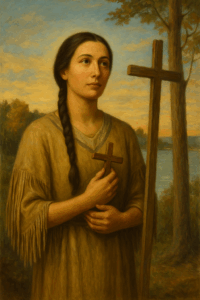

Saint Kateri praying in the woods

The Principle Virtues of Saint Kateri Tekakwitha:

  • Her Faith
  • Her Hope
  • Her Charity, Love of God
  • Her Love of Her Neighbor
  • Her Prudence
  • Her Devotion
  • Her Penance
  • Her Chastity
  • Her Obedience to the Lord

Precious (Kaiatanoron) Saint Kateri is venerated for her heroic faith, virtue, and love of Jesus, in the face of adversity and rejection.

Pope Francis said, “Saint Kateri Tekakwitha’s life is further proof that apostolic zeal implies both union with Jesus, nourished by prayer and the sacraments, and the desire to spread the beauty of the Christian message through fidelity to one’s particular vocation.”

Saint Kateri, please pray for us. ❤️

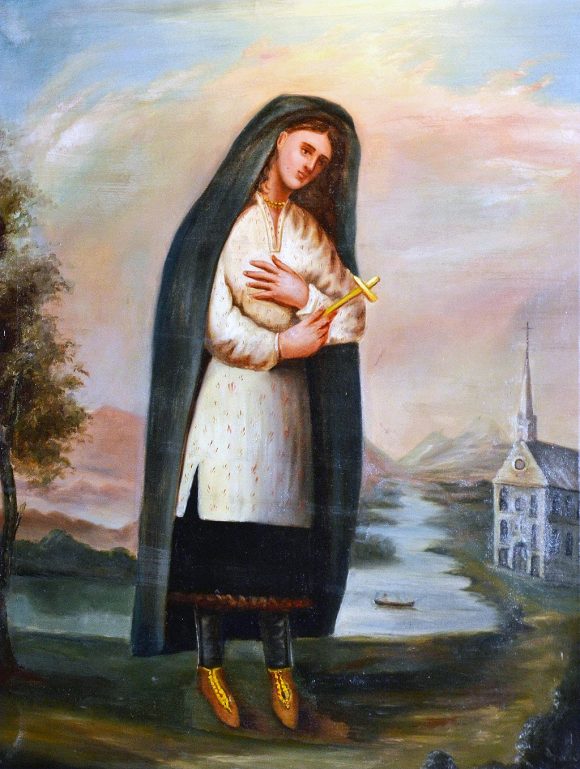
Father Claude Chauchetière painted the portrait of Saint Kateri by the river and church near the top of this page, a few years after her passing. He was one of two priests and others who witnessed Kateri’s death in 1680 at the age of 24. 
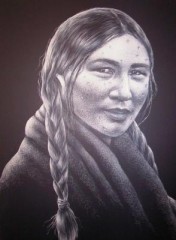
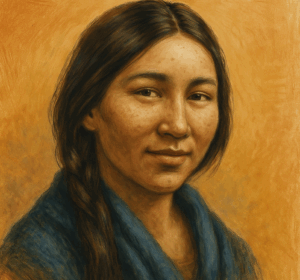
This portrait of Blessed Kateri Tekakwitha is by Lisa E. Brown. Lisa was commissioned to paint the patron saints of World Youth Day 2002. We thank Lisa for her wonderful and inspirational art.
A Prayer Through the Intercession of Saint Kateri Tekakwitha

For Those Walking the Saint Kateri Paths of Integral Ecology, by the Saint Kateri Conservation Center

Saint Kateri Tekakwitha, Beautiful Flower (Katsi’tsí:io) and Patroness of Ecology, please pray for us. As a daughter of the Kanienʼkehá꞉ka (Mohawk) and Algonquin nations, you walked the paths of forest and river, village and wilderness, following the call of Christ with courage, humility, and steadfast faith. Guide us as we walk our own paths, seeking to live in right relationship with God, one another, and all of creation. 

Teach us to walk gently upon the Earth, receiving the gifts of creation with gratitude and using them with wisdom and moderation. Help us to recognize the goodness, beauty, and order present in the lands, waters, plants, animals, and communities among which we live.  

Through your example, inspire us to practice stewardship rooted in reciprocity and responsibility, giving thanks for what we receive and caring for what has been entrusted to us. Grant us the wisdom to consider the needs of future generations, so that those who come after us may inherit a world rich in love, justice, and peace.

We remember with gratitude your mother, whose Algonquin heritage and Catholic faith helped shape your love for the Creator and care for creation, and whose witness prepared the soil in which faith would grow. Through her example and your own, may we honor the gifts that faith, families, and communities pass from one generation to the next.

As you journeyed more than two hundred miles from your homeland to the Catholic mission of Saint Francis Xavier at Kahnawake, help us persevere on our own pilgrimage of faith. May the paths we follow lead us ever closer to Jesus Christ, deeper into communion with God and his creation, and more fully into lives of love and service.

Saint Kateri Tekakwitha, pray that we may love God with all our heart, with all our soul, and with all our mind, and love our neighbors as ourselves, as you did in your life. Pray that we may protect and nurture life and care for the goodness of creation entrusted to us. May we help prepare the way for the restoration of all things in Christ. 

Amen.

Credit: Erin Green

“I love Kateri, who went through so much, whose faith was so strong that it carried her through difficult times. I think she’s a gentle reminder of a people who have been invisible, and yet have so much to offer.”

Deb Echo-Hawk, Pawnee Nation, Crux website, March 17, 2020

FROM THE HOMILY OF HIS HOLINESS POPE BENEDICT XVI

Saint Peter’s Square

Sunday, 21 October 2012

Kateri Tekakwitha was born in today’s New York State in 1656 to a Mohawk father and a Christian Algonquin mother who gave to her a sense of the living God. She was baptized at twenty years of age and, to escape persecution, she took refuge in Saint Francis Xavier Mission near Montreal. There she worked, faithful to the traditions of her people, although renouncing [some of] their religious convictions until her death at the age of twenty-four. Leading a simple life, Kateri remained faithful to her love for Jesus, to prayer and to daily Mass. Her greatest wish was to know and to do what pleased God. She lived a life radiant with faith and purity.

Kateri impresses us by the action of grace in her life in spite of the absence of external help and by the courage of her vocation, so unusual in her culture. In her, faith and culture enrich each other! May her example help us to live where we are, loving Jesus without denying who we are. Saint Kateri, Protectress of Canada and the first Native American saint, we entrust to you the renewal of the faith in the First Nations and in all of North America! May God bless the First Nations!

IN PRAISE OF BLESSED KATERI AT TIME OF BEATIFICATION

Rome Italy, 1980

Homily of Pope John Paul II

This wonderful crown of new blesseds, God’s bountiful gift to his Church, is completed by the sweet, frail yet strong figure of a young woman who died when she was only twenty-four years old: Kateri Tekakwitha, the “Lily of the Mohawks,” the Iroquois maiden, who in seventeenth century North America was the first to renew the marvels of sanctity of St. Scholastica, Saint Gertrude, Saint Catherine of Siena, Saint Angela Merici and Saint Rose of Lima, preceding, along the path of Love, her great spiritual sister, Therese of Child Jesus.

She spent her short life partly in what is now the State of New York and partly in Canada. She is a kind, gentle, and hardworking person, spending her time working, praying, and meditating. At the age of twenty she receives Baptism. Even when following her tribe in the hunting seasons, she continues her devotions, before a rough cross carved by herself in the forest. When her family urges her to marry, she replies very serenely and calmly that she has Jesus as her only spouse. This decision, in view of the social conditions of women in the Indian Tribes at the time, exposes Kateri to the risk of living as outcast and in poverty. It is a bold, unusual and prophetic gesture: on 25 March 1679, at the age of twenty-three, with the consent of her spiritual director, Kateri takes a vow of perpetual virginity – as far as we know the first time that this was done among the North American Indians.

The last months of her life are an ever clearer manifestation of her solid faith, straight-forward humility, calm resignation and radiant joy, even in the midst of terrible sufferings. Her last words, simple and sublime, whispered at the moment of her death, sum up, like a noble hymn, a life of purest charity: “Jesus, I love you…”

Excerpt from the ADDRESS OF HIS HOLINESS JOHN PAUL II

Memorial Coliseum, Phoenix 
Monday, 14 September 1987

Jesus speaks of the word of God as the seed which falls on good ground and produces abundant fruit. The seed has long since been planted in the hearts of many of you. And it has already produced the fruits which show its transforming power – the fruits of holiness. The best known witness of Christian holiness among the Native People of North America is Kateri Tekakwitha, whom I had the privilege, seven years ago, of declaring “Blessed” and of holding up to the whole Church and the world as an outstanding example of Christian life. Even when she dedicated herself fully to Jesus Christ, to the point of taking the prophetic step of making a vow of perpetual virginity, she always remained what she was, a true daughter of her people, following her tribe in the hunting seasons and continuing her devotions in the environment most suited to her way of life, before a rough cross carved by herself in the forest. The Gospel of Jesus Christ, which is the great gift of God’s love, is never in contrast with what is noble and pure in the life of any tribe or nation, since all good things are his gifts.

“He who feeds the birds of the air, will not let me want the little I need to live.”

– Saint Kateri Tekakwitha